
Liechtenstein’s fund industry is growing—Markus Hill spoke with David Gamper, Managing Director of the Liechtenstein Investment Fund Association (LAFV), on behalf of FINANZPLATZ FRANKFURT AM MAIN, about the specialization in private-label funds, the role of dialogue-oriented supervision, and the biggest obstacle to growth: international recognition. Other topics include the recent roadshow in London and the question of why the British market is particularly interesting for Liechtenstein in the long term. On November 10, 2026, the LAFV will continue the dialogue in Frankfurt.
Hill: How is the Liechtenstein fund industry performing this year?
Gamper: We can be very satisfied with the first half of the year. Assets under management have risen by about 9%. Slightly more than a third of this growth is attributable to net inflows, with the remainder coming from price and currency gains. The number of new fund launches is also above last year’s level. This came as quite a surprise to us, as many of our members were simultaneously heavily occupied with implementing AIFMD II. These regulatory adjustments tied up significant personnel and organizational resources. It is therefore all the more gratifying that the industry was nevertheless able to maintain its growth momentum.
Hill: You were just on a roadshow in London—not for the first time. Do you sense a change in the UK now?
Gamper: Yes, we’re seeing a very encouraging trend. Until a few years ago, Liechtenstein as a fund domicile was virtually unknown in the UK . We therefore had to lay the groundwork first and build awareness of the location in the first place. We only began targeted market development a few years ago; relative to the size of the UK market, we’re still operating on a comparatively modest budget. This makes it all the more gratifying that our efforts are increasingly bearing fruit. The number of participants in our roadshows is growing with each event. We’re having significantly more in-depth discussions with asset managers and service providers and are receiving more concrete inquiries. This is now also reflected in a growing number of funds being established in Liechtenstein by British asset managers. The British market is one of the largest and most international fund and asset management markets in Europe. Awareness and trust do not develop overnight there. However, developments to date show that Liechtenstein—with its short decision-making processes, high regulatory standards, and access to the European single market—is attracting increasing interest. We are convinced that in the UK, we are only at the beginning and still have considerable growth potential.
Hill: Liechtenstein is considered an important location for private-label funds. What is its particular strength?
Gamper: In recent years, Liechtenstein has deliberately positioned itself as a center of excellence for private-label funds. While major fund domiciles such as Luxembourg or Ireland primarily cater to international asset managers with very large fund volumes and structure their operations around economies of scale, Liechtenstein focuses on a different market segment. Here, private-label funds are not a niche product, but rather the core of the fund market. That is why all stakeholders—fund managers, custodian banks, specialized service providers, and the financial market supervisory authority—share a common interest in continuously improving the framework conditions for fund initiators and designing efficient processes. Independent asset managers, family offices, banks, and specialized asset managers in particular benefit from this unique positioning of Liechtenstein as a fund center. They find contacts who understand their business model, short decision-making paths, and a regulatory environment that enables innovation while ensuring high quality and compliance standards. This specialization is a genuine competitive advantage: In Liechtenstein, fund initiators are not just one of many clients—they are the focus of attention. This enables close collaboration, customized solutions, and a high quality of service—factors that are crucial in the private-label business.

Hill: What role does the Financial Market Authority play in the location’s attractiveness?
Gamper: The Financial Market Authority is a key factor in our success. An attractive fund center requires high regulatory standards and legal certainty, but also a regulator that seeks dialogue with market participants and facilitates efficient processes. It is precisely this combination that sets Liechtenstein apart. A particular advantage is the close and direct communication. Every fund company has a personal point of contact at the Financial Market Authority. Regular communication is not only possible but expressly encouraged. This is particularly helpful when dealing with more complex fund structures or innovative asset classes: early dialogue clarifies regulatory issues and efficiently prepares the approval process. The division of roles remains clear throughout. The Financial Market Authority does not act in an advisory capacity, but sees itself as an accessible and dialogue-oriented authority. Verena Schlömer of the Financial Market Authority recently put this aptly before fund sponsors: “We are not advisors, but we are happy to consult with you.” This statement sums up the Liechtenstein approach very well: talking to one another early on, fostering mutual understanding, and finding solutions within the regulatory framework. Short decision-making paths, dedicated points of contact, and constructive dialogue provide planning certainty. This allows even challenging fund projects to be implemented efficiently. Many market participants particularly appreciate this distinction when comparing Liechtenstein to other international markets.
Hill: How does European regulation affect a small fund center like Liechtenstein?
Gamper: European regulation naturally has a noticeable impact on a small fund center. For small and medium-sized companies—which are typical here—implementing new requirements often entails considerable effort and additional resources. At the same time, Liechtenstein has an important advantage: The regulator implements European requirements in a targeted manner and—unlike some other fund centers—avoids imposing additional restrictions beyond those set by Brussels. This pragmatic approach strikes a balance between necessary regulation and competitiveness. Both local companies and fund sponsors benefit from this. They receive a reliable regulatory framework without unnecessary additional hurdles. For a small fund center, it is crucial to remain efficient while meeting high European standards.
Hill: What is currently the biggest obstacle to further growth?
Gamper: In our view, the biggest obstacle is not the quality of the location, but its visibility. Anyone who gets to know Liechtenstein as a fund location more closely is generally convinced by the framework conditions and the ecosystem’s capabilities. Many then wonder why growth isn’t even stronger—and usually reach the same conclusion: Liechtenstein’s strengths are still not well known internationally. Luxembourg and Ireland have been established as fund domiciles for decades and invest significant resources in their international marketing. Our association is working with a comparatively limited budget to gradually increase awareness—through roadshows, social media, and direct engagement with fund sponsors such as asset managers, wealth managers, and family offices. I am convinced that the more potential fund sponsors get to know Liechtenstein, the stronger the growth will be. Our task, therefore, is to further increase visibility and promote the location’s strengths even more effectively in international markets.
Hill: When will you be in Germany next?
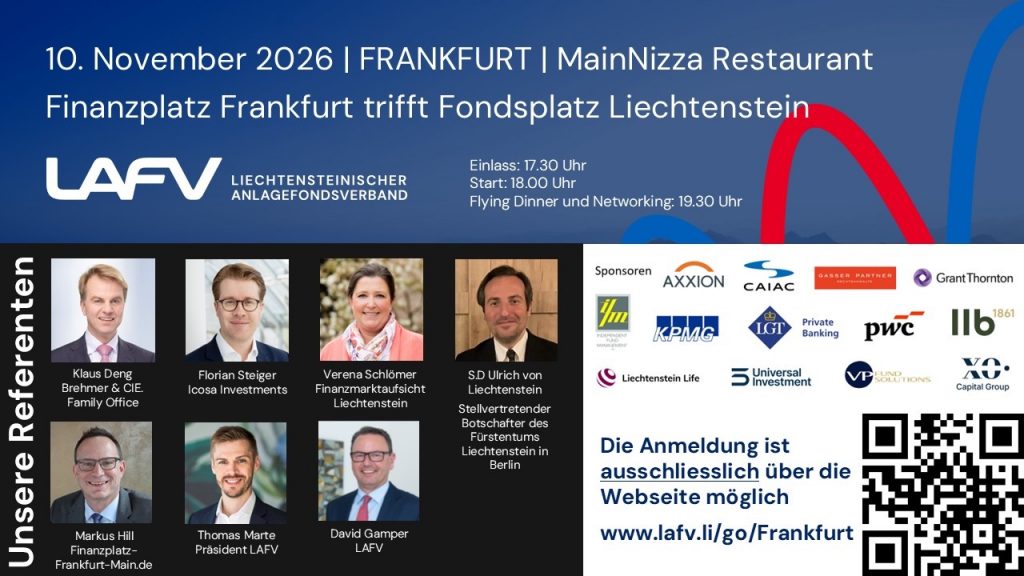
Gamper: We’ll be in Frankfurt on November 10, 2026. Joining us will be the Deputy Ambassador in Berlin, H.E. Ulrich von Liechtenstein; Klaus Deng, Senior Partner at Brehmer & CIE. Family Office; Verena Schlömer from the Liechtenstein Financial Market Authority ( ); Florian Steiger, CEO and founder of Icosa Investments AG; Thomas Marte, President of the LAFV; and myself. Those interested can find more information and register on our website.
Hill: Thank you very much for the interview.
Frankfurt as a Financial Center Meets Liechtenstein as a Fund Center” – Event Announcement & Registration:
Dialogue & Information:
FINANZPLATZ FRANKFURT AM MAIN on LINKEDIN – CHANNEL
FRANKFURT AM MAIN FINANCIAL CENTER on LINKEDIN – GROUP
FUND BOUTIQUES on LINKEDIN – CHANNEL
FINANZPLATZ-FRANKFURT-MAIN.DE, DACHLI Region & FONDSBOUTIQUEN.DE (2026) – Topics, Interests, Dialogue (Selection & “Snapshots”)
February 25, 2026, Frankfurt – “Frankfurt am Main Financial Center Meets Wealth Management”
(Markus Hill – Moderators: Christian Neuhaus – FINVIA, Sven Karkossa – Capitell Vermögens-Management AG, Noel Zeh – Wunderland Capital)
February 26, 2026, Frankfurt – “Forum for Digital Assets (FDV)”
Editorial Team – Special Feature “Frankfurt am Main Financial Center Meets Wealth Management & Digital Assets”
(Interviews / Guest Contributions, “Support” & MORE: info: markus-hill.com)
March 17, 2026, Frankfurt – Private Markets Excellence Forum – “Private Markets, Family Offices & Foundations – Due Diligence & Outlook 2026”
(Markus Hill – Fireside Chat: J. Paulo Dos Santos – Managing Director, VIRATIO GmbH)
Interview with Christian Hommens – SMART IMPACT INVESTING & PRIVATE MARKETS
Spring 2026: Investor Study “Preferences of Institutional Investors in Real Estate & Alternative Investments”
(Markus Hill – Moderator, Podcast: Sebastian Thürmer, “artis & x” – Example 2025)
April 16, 2026 – “köln let’s talk” – Bettina Timmler – Real Estate & Dialogue
(Media Partnership)
May 12, 2026, Frankfurt: “Value Investing & Commodities & MORE”
(Markus Hill – Moderator & brief introduction “Fund Boutiques & the U.S. Formula” – Alex J. Rauschenstein & Urs Marti, SIA FUNDS AG – FINANCIAL CENTER SWITZERLAND)
June 17, 2026, Zurich: Insights – “Family Offices & Fund Boutiques” – The Mountain Talks Summit – FUNDPLAT
(Presentation – Markus Hill)
September 24, 2026, Lucerne: “Swiss Digital Finance Conference 2026” – Markus Hill (PARTNER) speaks with Jan Carlos Janke, lecturer in Digital Business & Innovation at Lucerne University of Applied Sciences and Arts – Computer Science
November 10, 2026, Frankfurt: “Frankfurt am Main Financial Center Meets Liechtenstein Financial Center”
(Markus Hill – Moderator – LAFV Liechtenstein Investment Fund Association: Panel & Presentations)
Input, ideas, and suggestions on the topics mentioned above are welcome:
info@markus-hill.com / +49 (0) 163 4616 179
Photo: Pixabay
Source: IPE D.A.CH