
Family office topics have significantly expanded in scope in recent years. In addition to traditional investment issues, governance, succession, corporate investments, international structures, and the professional coordination of various experts are taking center stage. In the run-up to the Family Office 2026 Annual Conference, Markus Hill of Finanzplatz Frankfurt am Main spoke with Dr. Sigrid Mulas, Managing Director of Fürstenberg’s Specialized Seminars, about the event’s further development, the redesign of the “Certified Family Officer (FvF)” program, and the question of what skills family officers need today. Of particular interest was the focus on the intersections: Family office work is not limited to individual disciplines. Rather, what matters most is how legal, tax, financial, family, and governance issues are integrated in practice. The conversation also provided insights into the key topics of the 2026 annual conference in Bad Neuenahr, as well as the development of a professional and networking environment surrounding the Certified Family Officer training program.
Hill: Dr. Mulas, the 2026 Family Office Annual Conference is set to undergo some changes. What’s new?
Mulas: We are clearly evolving the 2026 Annual Conference. For one thing, after five years, it will take place in Bad Neuenahr this year. For another, Dr. Florian Oppel will take over as conference chair alongside Dr. Henning Schröer. This also allows us to set a new tone in terms of content. The annual conference is intended to become even more of a forum where current family office issues are not only presented but also analyzed from a professional perspective and openly discussed.
Hill: What sets your annual conference apart from traditional wealth management, private banking, or investment conferences?
Mulas: Many events in this field view family offices primarily as investors or a target audience for products. That’s too narrow for us. Our focus is on the overall architecture of complex family wealth: family, business, assets, governance, succession, risk, legal matters, taxes, and investments. Investment topics play a role, but not in isolation. The key question is: What must a family office be able to understand, coordinate, and assess in order to provide professional, long-term stewardship of family wealth?
Hill: Can you tell us anything yet about the 2026 program?
Mulas: Yes, the program has now been published and clearly illustrates the direction in which the annual conference is evolving. We begin with the question of how family wealth can be strategically safeguarded in times of crisis, and then cover succession and structural measures, real estate, strategic asset allocation, private debt, and minority stakes in family businesses. On the second day, the focus will be more on operational and governance-related issues: AI in the family office, family office governance, the advisory board, as well as communication and reputation management for entrepreneurial families. In this way, the conference covers exactly the breadth of topics that modern family office work demands today: wealth, family, business, governance, investments, and risk must all be considered together.
Hill: Are there any program highlights you’d particularly like to draw attention to?
Mulas: All the presentations promise exciting insights because they offer different perspectives on the day-to-day operations of professional family offices. However, two topics may be of particular interest to your readers: first, strategic asset allocation for entrepreneurs and entrepreneurial families, because here, investment is viewed not in abstract terms but through the lens of the principals’ thinking and decision-making logic. Second, private debt, as this asset class is becoming increasingly relevant for family offices and other professional investors and requires a disciplined assessment of returns, risk, segments, and selection criteria. Additionally, the presentation on minority investments in family businesses is fascinating because it combines family equity, long-term partnerships, and governance issues. However, it’s important to note that the annual conference is not just a series of presentations. The exclusive alumni gathering of Certified Family Officers (FvF) and the group dinner provide a setting where these topics can be explored further in confidence.
Hill: “Networking” is a common promise in the professional development industry. In your view, when does this actually translate into professional value?
Mulas: When a network isn’t just open to anyone and is based on a shared professional foundation. That’s exactly the case with our graduates. They’ve completed the same program, share a basic understanding of professional family office work, and then reconnect at the annual conference or at regular get-togethers. This fosters not only connections but also trust—and trust is a true foundation for work in this field.
Hill: How large has this network grown?
Mulas: Since the program began in 2017, around 130 participants have earned the Certified Family Officer (FvF) designation. This isn’t a mass program, but rather a community that has grown organically. In 2026, we redesigned the program because the requirements for family officers have changed.
Hill: What was no longer sufficient about the previous program design?
Mulas: The demands placed on Family Officers have evolved significantly, and over the past nearly ten years, we’ve received a great deal of feedback and developed further expertise. In practice, it’s becoming even more evident today that professional family office work doesn’t fail due to a lack of specialized knowledge, but rather due to a lack of integration: law, taxes, assets, family, governance, and risk must be considered together. The topics of value creation and international context are of paramount importance. That is why we have fundamentally redesigned the 2026 program—based on numerous previous programs, participant feedback, and evolving professional perspectives. The goal is no longer the accumulation of knowledge, but rather the systematic development of professional competence.
Hill: What specifically has changed as a result of the redesign?
Mulas: We have structured the program more closely around the reality of decision-making in a family office. The modules do not simply follow individual subject areas but integrate the core areas of expertise: the role and organization of the family officer, law and taxes, corporate and wealth succession, asset allocation and reporting, as well as liquid, real estate-related, and illiquid investments. Above all, what’s new is the stronger learning framework: assessing initial situations, understanding underlying structures, responsibly weighing decisions, and implementing them for the long term. This transforms specialized knowledge into a comprehensive professional understanding.

Hill: Which topics are now essential components of family office training, even though they were previously treated as rather peripheral?
Mulas: In addition to the traditional fields of law, taxes, and wealth structuring, today’s curriculum primarily includes governance, organization, succession processes, risk management, international aspects, asset allocation, reporting, investment governance, and illiquid investments. It is precisely these intersections that are crucial: a tax-efficient structure can be difficult to explain to family members; an investment decision can raise governance or liability issues; and the expertise of external advisors must be integrated without delegating decision-making responsibility. It is precisely these points of intersection that define modern family office work.
Hill: How do you ensure that interdisciplinarity doesn’t remain just another term for thematic breadth?
Mulas: By consistently working at the interfaces. For example, a real estate decision is never just a real estate decision. It can have tax, legal, family, financial, and governance-related consequences. The same applies to succession planning, equity investments, or security issues. The program is designed to train students in precisely this way of thinking: not in silos, but within broader contexts.
Hill: What should a graduate be able to assess or decide more professionally afterward than before?
Mulas: He or she should be able to analyze complex situations in a more structured way. What interests are at play? Which risks are visible, and which are not yet apparent? Which experts need to be involved? Where might there be conflicting goals? And which decision is not only technically sound but also sustainable for the family in the long term? In my view, that is the core of professional family office work.
Hill: The quality of instructors is often touted in continuing education programs. How do you ensure that the course isn’t dominated by product-driven agendas or mere self-promotion?
Mulas: We select speakers based on whether they are technically excellent and, at the same time, have genuine experience with complex wealth, family, or corporate structures. What matters is not just reputation, but the ability to convey knowledge in a practical, application-oriented way. Product-focused presentations do not fit this format. Our participants do not expect sales presentations, but rather guidance, substance, and practical experience—both in the course and at the annual conference.
Hill: The term “Family Officer” is not a protected designation. What can a “ ” certification course achieve in this market?
Mulas: A training program cannot legally protect the term. But it can create transparency. The Certified Family Officer (FvF) designation demonstrates that someone has systematically engaged with the core areas of responsibility, interfaces, and levels of accountability. It does not replace experience, but it establishes a clear qualification profile in a market that is often highly inconsistent.
Hill: When you consider the training program and the annual conference together, what do they offer that a single seminar or a traditional conference cannot?
Mulas: The course lays the professional foundation. The annual conference brings topics up to date, broadens perspectives on new developments, and brings together different viewpoints. The roundtable discussions deepen the exchange in smaller groups. By establishing additional committees and formats—such as the Scientific Advisory Board or the practice-oriented webinar series “Family Office Inside,” which addresses current relevant topics—we have significantly expanded the certification program without arbitrarily broadening the participant base. Taken together, this creates an ongoing professional and networking environment for people who want to engage in family office work seriously and professionally.
Hill: What would you consider a good outcome if someone attends the course and subsequently remains part of this community?
Mulas: That this person not only knows more, but also asks questions differently—in a more professional, structured, and forward-thinking way. Good family office work often begins with asking the right questions before decisions are made. If graduates can identify risks earlier, coordinate specialists more effectively, and manage family wealth in a more holistic manner, then the program has served its purpose. If alumni maintain and further develop the network among their peers on a long-term basis and on their own initiative—that is their additional, lasting benefit.
Hill: Thank you very much for the interview.
Event Announcement: “Annual Family Office 2026 Conference”
Dialogue & Information:
FINANZPLATZ FRANKFURT AM MAIN on LINKEDIN – CHANNEL
FINANZPLATZ FRANKFURT AM MAIN on LINKEDIN – GROUP
FUND BOUTIQUES on LINKEDIN – CHANNEL
FINANZPLATZ-FRANKFURT-MAIN.DE, DACHLI Region & FONDSBOUTIQUEN.DE (2026) – Topics, Interests, Dialogue (Selection & “Snapshots”)
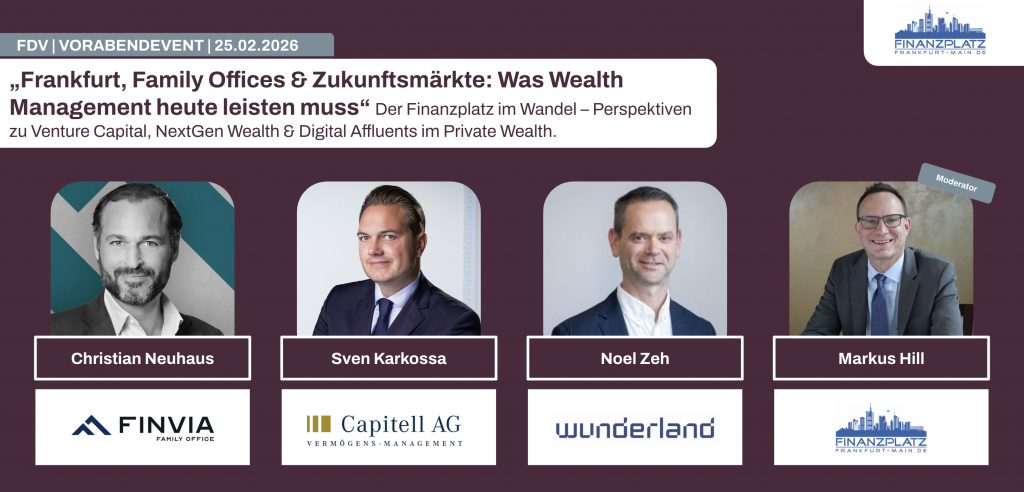
February 25, 2026, Frankfurt – “Frankfurt am Main Financial Center Meets Wealth Management”
(Markus Hill – Moderators: Christian Neuhaus – FINVIA, Sven Karkossa – Capitell Vermögens-Management AG, Noel Zeh – Wunderland Capital)
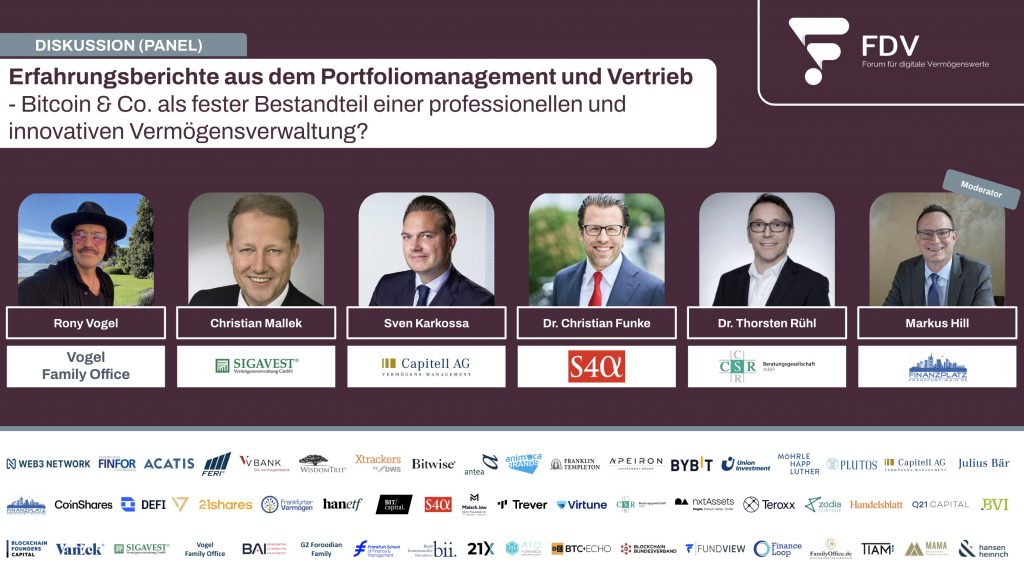
February 26, 2026, Frankfurt – “Forum for Digital Assets (FDV)”
Editorial Team – Special Feature “Frankfurt am Main Financial Center Meets Wealth Management & Digital Assets”
(Interviews / Guest Contributions, “Support” & MORE: info: markus-hill.com)
March 17, 2026, Frankfurt – Private Markets Excellence Forum – “Private Markets, Family Offices & Foundations – Due Diligence & Outlook 2026”
(Markus Hill – Fireside Chat: J. Paulo Dos Santos – Managing Director, VIRATIO GmbH)
Interview with Christian Hommens – SMART IMPACT INVESTING & PRIVATE MARKETS
Spring 2026: Investor Study “Preferences of Institutional Investors in Real Estate & Alternative Investments”
(Markus Hill – Moderator, Podcast: Sebastian Thürmer, “artis & x” – Example 2025)
April 16, 2026 – “köln let’s talk” – Bettina Timmler – Real Estate & Dialogue
(Media Partnership)
May 12, 2026, Frankfurt: “Value Investing & Commodities & MORE”
(Markus Hill – Moderator & brief introduction “Fund Boutiques & the U.S. Formula” – Alex J. Rauschenstein & Urs Marti, SIA FUNDS AG – FINANCIAL CENTER SWITZERLAND)
June 17, 2026, Zurich: Insights – “Family Offices & Fund Boutiques” – The Mountain Talks Summit – FUNDPLAT
(Presentation – Markus Hill)
September 24, 2026, Lucerne: “Swiss Digital Finance Conference 2026” – Markus Hill (PARTNER) speaks with Jan Carlos Janke, lecturer in Digital Business & Innovation at Lucerne University of Applied Sciences and Arts – Computer Science
November 10, 2026, Frankfurt: “Frankfurt am Main Financial Center Meets Liechtenstein Financial Center”
(Markus Hill – Moderator – LAFV Liechtenstein Investment Fund Association: Panel & Presentations)
Input, ideas, and suggestions on the topics mentioned above are welcome:
info@markus-hill.com / +49 (0) 163 4616 179
Photo: Unsplash & Frankfurt Financial Center
Source: IPE. DA.CH